

Epiphanic Moments
What’s calling you now?

This past Friday I recorded a guest spot on a new podcast “Common Unity” here in my Kingston-area community (NY). Sometime during the pandemic, my friend Tony (Marmo) pulled together a group of folks whom he thought would work well together to address some discord and divisive issues in our community. In his wisdom, he called that group Common Unity. (Which I love as a play on the word community!) I was/am happy to be part of this thoughtful and diverse group. While we are currently planning some dialogue sessions, Tony and his co-host, Don, (The Rev. Don Mapes) started a podcast (at our wonderful community radio station, Radio Kingston) to let people know we are out there, and they invited me to talk about peace education and ways to build common unity.
At some point during our chat, I shared a tidbit about my research with young people, wherein I hypothesized that many of them (and, well, many of us called to do justice/peace work) had an “epiphanic experience”; a moment, or series of moments, that laid bare the truth of the world. This involved seeing—perhaps for the first time—just how unjust things are.
One of my Epiphanic Experiences goes back to 1992 when I volunteered in Guatemala (during their civil war). On my first morning in Guatemala City, as I emerged from the $3 hotel I spent the night in, I was greeted by a parade of indigenous women of all ages. And they were carrying signs. The sentiments translated to: “Where are our fathers? We are our husbands?” They were marching to call to consciousness the “disappeared”, the Desaparecidos, thousands of people—mostly indigenous men—who were “disappeared” or murdered by the Guatemalan government with full backing from the US government. All told, the Guatemalan genocide during their Civil War (1960 - 1996) counts at least 200,000 deaths.


(I thought I had photos of this moment, but I can’t find them. So, here’s a photo of a Guate flower market, and one of me and my adopted brother, Angel, playing cards. 1992).
To say that my time in Guatemala changed me would be a massive understatement. After my time there, I returned to the US to become a teacher, since I believed that education—especially an education that laid bare the facts about US militarism and the culture of war and destruction that we live in—could indeed be a liberatory act. I started teaching at the American Indian Heritage School, and more epiphanies followed. (Those stories will be shared at some point).
During the Common Unity podcast recording, we talked about how challenging it is to feel like your work matters on a global scale, and thus we focused on what we can do locally. How creating local communities grounded in peace and justice can be impactful. And it reminded me of conversations I regularly have with my students, who amidst the madness of our world that makes them feel overwhelmed or unable to enact any kind of change, ask me: where do we even begin? And I’m always reminded of the simple sage wisdom of Arthur Ashe:
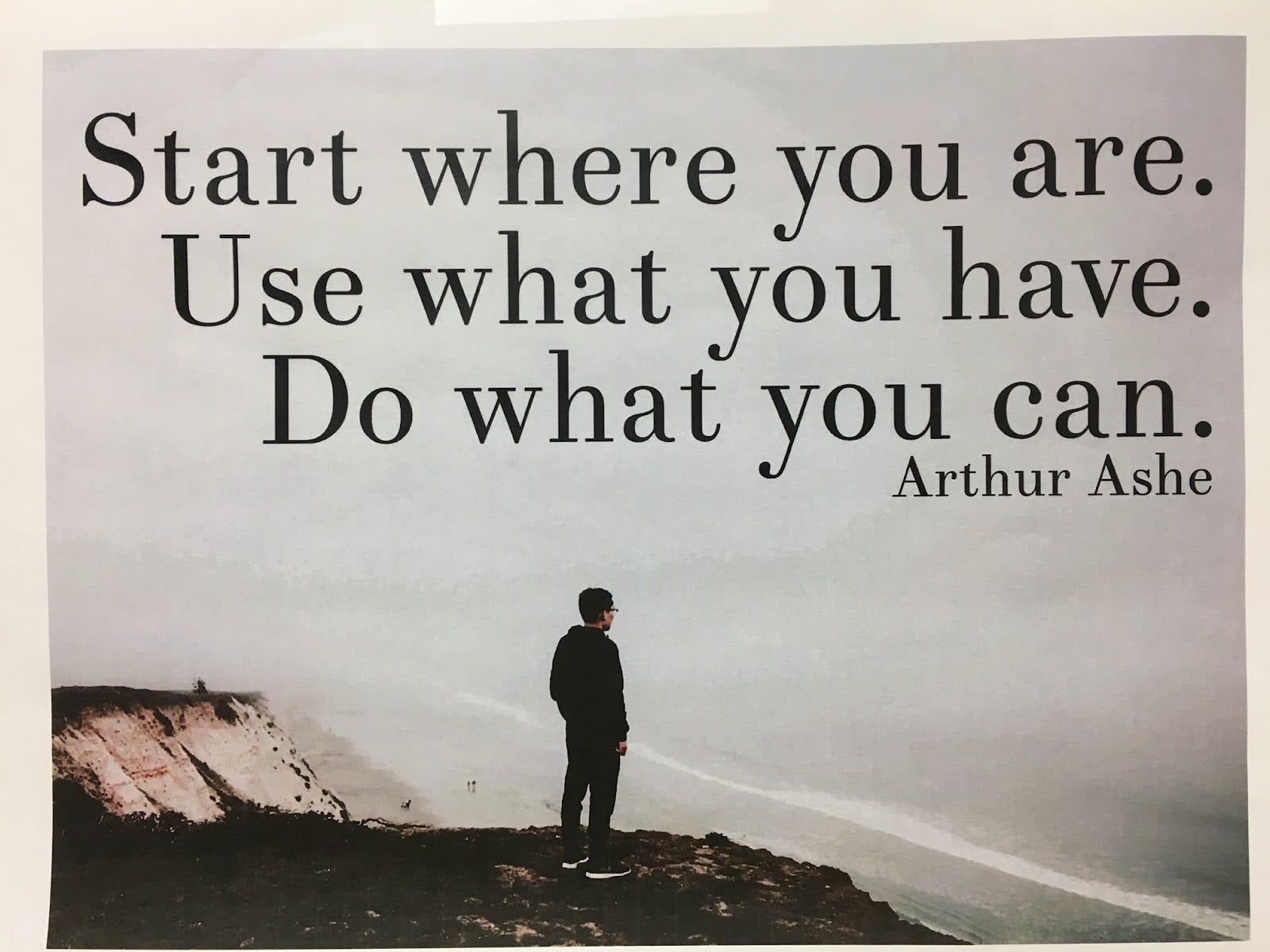
(Start where you are. Use what you have. Do what you can. - Arthur Ashe)
Feel free to share your epiphanic experiences in the comments!