

From thoughtlessness to...?
(Sorry this is late, it's been a helluva week)

I think about violence and power a lot. It’s part of the deal when one is a peace researcher and peace educator. In previous posts I’ve explained why violence is the baseline of my worldview [read this and others] and power is part of that equation. When I teach, I invite students to examine things close-up (locally or situationally) and then to pull back the lens to get a systems-level view. We do this to debunk educational myths and to examine climate chaos and environmental injustice. We do it when talking about international education practices and the challenges that come with adolescence. It must be done to ensure that we are getting the full picture of a situation. All too often, people simply look at manifestations of issues and then jump to blame - which focuses on small or local causes. Usually this type of surface level judgment or attempt at understanding is far too limited and that’s why every issue we talk about has to be examined through Root Causes (more on that here).
Many years ago, I started calling this Root Cause analysis my “fly-eye lens” so that we can train our minds to look at any issue through a truly and complexly intersectional lens. Just this week, my seminar came up with this list of ways to examine an issue.
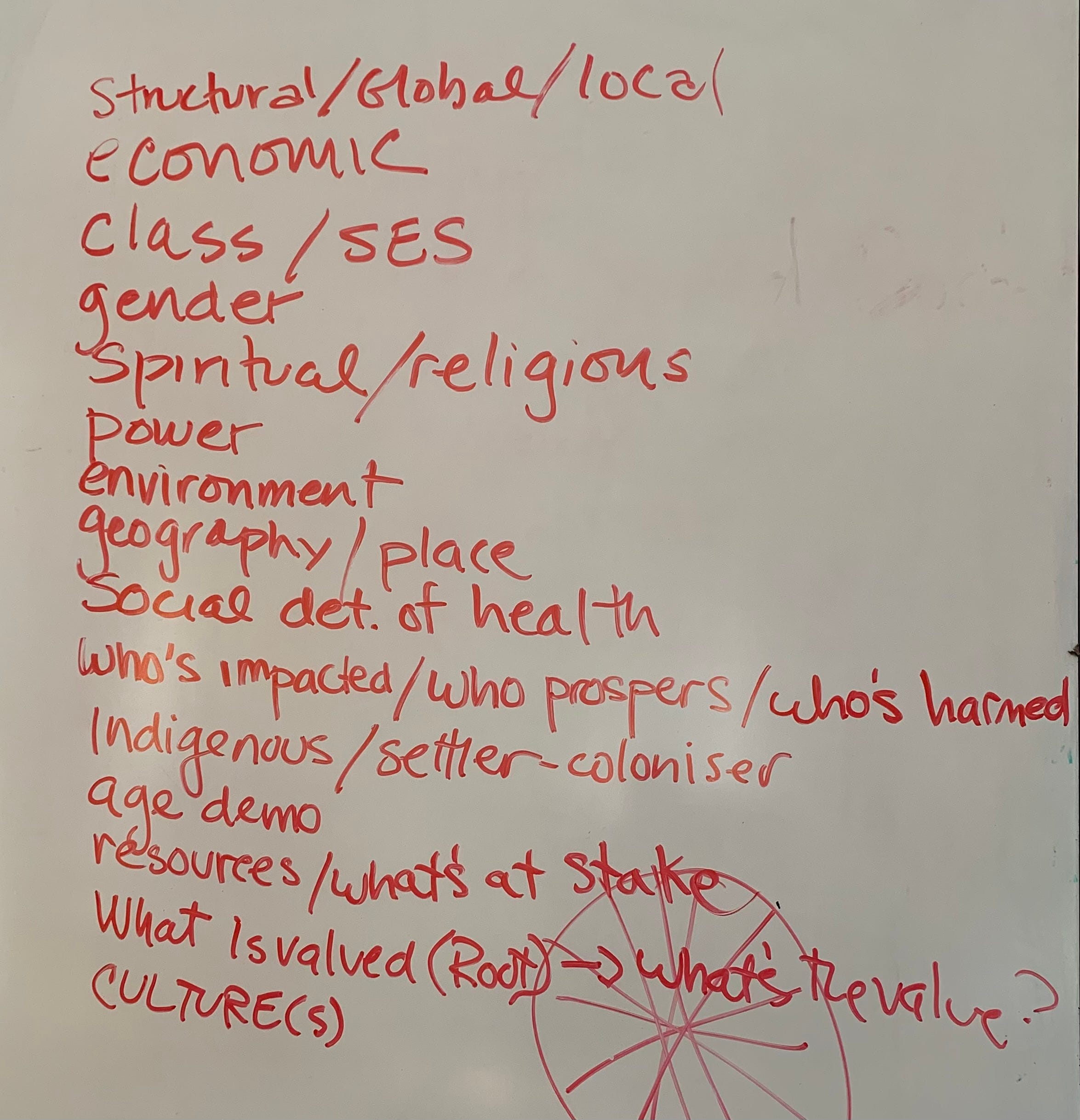
The reason I am so vehement about doing this type of analysis is because we don’t think enough. Today, perhaps more than any other time in the US since I’ve been alive (born in the late 1960s) people are sheep. People can’t talk to one another. Extremist views have been “normal” by a self-aggrandizing dangerous clown (and his minions). If we don’t literally question everything that is happening right now (and for many years prior but sadly, time travel is not an option yet) we are setting ourselves up to be actors in a horrific play.
Each year in my course that examines adolescence deeply, we read a piece that I personally love, but that is often quite challenging for students. It’s a few chapters from the book The Evil of Banality by Elizabeth Minnich. Minnich’s central point is that thoughtlessness will always allow bad things to happen. She uses numerous examples in history when neighbors, lulled into either complacency or rabid violence killed people who were once friends, customers, acquaintances thinking nothing of it. As she says, “people who are not thinking are capable of anything”.
She, like me, believes that education is one way to break out of this unthinkingness (my made up word, not hers!) She says, “education is at the very least a crucial strand of the weave of efforts we are morally required to explore if we are ever to make Never Again anything other than a tragically failed cry of the heart.” I would argue that we have already made Never Again a tragically failed cry of the heart.
How do we get people to think? To see beyond themselves? To foster attentiveness? To care? How do we make sure that the average person’s thoughtlessness doesn’t get weaponized by authoritarianism (like it already has)? How do we address the ongoing “distancing” people feel to those who are not like them? (And if I’m being frank, what I really mean is how do we get white people, and white cis-het-men especially, along with the women who cling to them via their internalized misogyny and white supremacy to stop vilifying all who are not like them?)
I believe that a good share of this thoughtlessness is in our DNA, since the USA was founded on genocide and systemic and systemized racism. But I also believe that we can do better.
I have chosen to do it through peace education and interfaith ministry. I’d love to hear stories from others…