

Keep on Keepin' On
My Keynote from NYUU Justice Convocation

{I may be back! While I figure out a schedule, here’s a longer read. I hope to have a video recording of this soon.}
Good morning, everyone. I’m so grateful to be with you all today. Actually, I found myself quite challenged while writing this because the world has just been making me so weary. I feel like every day I wake up and think, “Well, what fresh new hell awaits us today”. Maybe some of you can relate. In July 2024, after crying in classes a couple of times, I made the decision to go back on antidepressants. In March of this year (2025), I made the bold step to close all of my social media accounts since my mental health was once again in serious decline. Well, it was a combination of not wanting to scroll or get sucked into the abyss of doomsday images and news, and maybe more importantly, not wanting to be connected in any way with these companies that make money off of us, soften our brains, and steal our data. I made the tough decision to keep my non-profit, The Peace Education Center of the Hudson Valley, on some of the apps and have a wonderful 24-year-old partner-in-action who handles all of that. They don’t have the same addictive personality or ADD and anxiety-depression that I have! We do talk a lot about how to promote our good work in a world that relies so heavily on online media for information exchange. We’re still figuring it out.
I say all this as a reminder of how much information is out there and how we can easily fall into a cycle of information overload. I imagine that all of us gathered here are fully aware of the various horrors happening in the United States and around the world, so I question how helpful it is for us to absorb image after image and story after story of so much suffering. At first, it feels informative, and I know there is really important information out there. But my concern lies in that place where witnessing - even from a distance - is so very different from acting. Does the continual witnessing fire us up to act more, or does it deplete us and make us feel powerless?
I recently completed a two-year training program with the Zen Peacemakers Order and was inducted into the order a few months ago. Our three central tenets are: Not Knowing, Bearing Witness, and Taking Action. Living into Not Knowing has been my most significant spiritual practice and mode of existence since I first went to Al-Anon twenty years ago. On both a personal level and as a practice to try to understand the nature of the universe, not knowing is an incredibly helpful tool. Instead of making unhealthy assumptions, ask questions. Instead of trying to find the one right answer, live into uncertainty. Instead of thinking you know all the things, humbly go about exploration and observance, and learning. And in ZPO, we start with not knowing as a guide to where we might go to get more knowledge, information, or experience. Which is where Bearing Witness comes in. And this is where I started to struggle with the teachings of my group. I fully agree with the idea of bearing witness. We cannot possibly truly understand the suffering of others if we don’t witness it through conversations or attendance at meetings or events, or the like. ZPO is excellent at bearing witness. They host retreats at Auschwitz and in Alabama to be immersed in sites of historic atrocities. People need this. Sometimes the only way to unlock one’s compassion or empathy is by being up close. Now, many of us just do that as part of our work. I, like many of you, have probably had jobs or volunteer roles in settings that were fraught with human suffering, and those positions were great teachers of the human condition and hopefully released or reinforced within us the desire to act, to change things, to be a compassionate listener or a freedom fighter. Because, bearing witness, for me, must always lead to action. I am one of those people who believe - and you can disagree with me - that if you are not working for change, you are complicit in the problems of the world.
I actually went seeking ZPO because I was let down by how the UUA responded (or didn’t respond, rather) to the slaughter of innocent Palestinians. I had hoped that a community with the aforementioned three tenets would give me a space where I could honestly share my sorrow and rage and discuss action plans with others who were horrified by what was happening. At that point, I was already part of conversations with other UUs discussing the issue as well as a member of Faculty and Students for Justice in Palestine (I teach at Vassar College), supporting the activism of our students, educating the university community, and taking our own actions as people of conscience.
ZPO also let me down, and I requested a one-on-one meeting with one of our lead teachers. His response to my concerns and queries was sound: we (ZPO) exist to give people (Buddhists) a space to learn about and apply these three tenets, but we don’t take a particular stance or lead actions per se. Fair enough. Not their thing. He also acknowledged that many of the people in my global cohort - folks from Brazil, Germany, Australia, Sweden, the USA, and more - might be new to the idea of Taking Action. He reminded me that while I had been doing this work for 40 years, others were just dipping a toe in the pool. Again, fair enough. There is a learning curve to taking action. In the end, I stuck it out and found colleagues - some UU/Buddhists like me - who were open to processing how to be in this community with conflicting views on our role in the world. And still, the question that I still carry and still wonder about and regularly dig into with my young adults is how much do we need to witness before we know that something needs to be done?
Killing children? Planetary breakdown? Forced migration? Masked men conducting kidnappings? Loss of bodily autonomy? Sexual trafficking of minors?
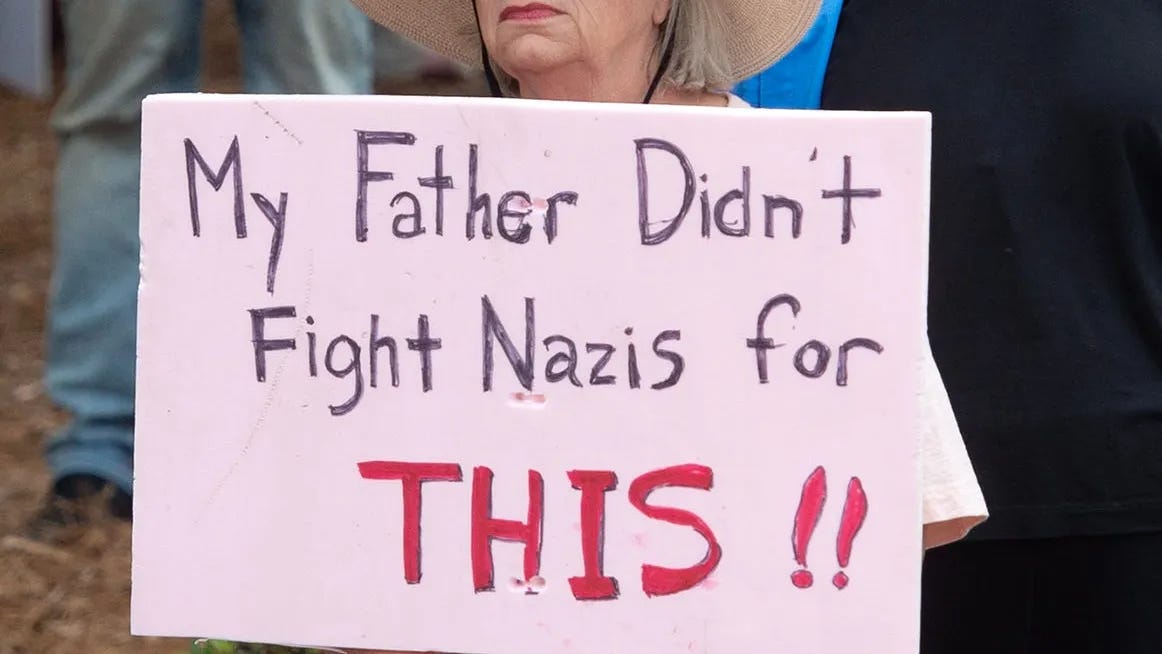
One image or article about any one of these things should be enough to snap anyone out of their comfort zone, but all of them? At the same time? When all of these things and more are happening and getting worse, action seems absolutely necessary. And we are all gathered together today because we are the ones we’ve been waiting for. We have eyes wide open and want to learn more, do more, be more.
Since we are now living in conditions similar to Germany in 1938, we must resist. Remember that it took the Nazi party one month, three weeks, two days, and eight hours and 40 minutes to dismantle a constitutional republic. Our current leadership is taking a little bit longer, but make no mistake, they are doing the same thing. Unlike what the Borg told us, resistance is not futile; it is necessary. Powerful, tyrannical regimes rely on apathy, complacency, and inaction. We must practice non-capitulation.
So, our theme today is moving from Revival to Resistance? And I chose the title “Keep on Keeping on”. Let’s unpack these concepts for a moment. Revival, to me, feels like a relighting of a spark, or perhaps more strongly, the rekindling of our UU flame, a reminder that in the words of Dr King, “injustice anywhere is a threat to justice everywhere.” That our faith is not a passive one. We are not descended from folks who watched but didn’t act. Rather, we are descended from those who made it a central part of their religious and spiritual calling to do the work of justice. And thus, Resistance is the only answer, and today I want to share some more thoughts about resistance and her necessary companion, Resilience.
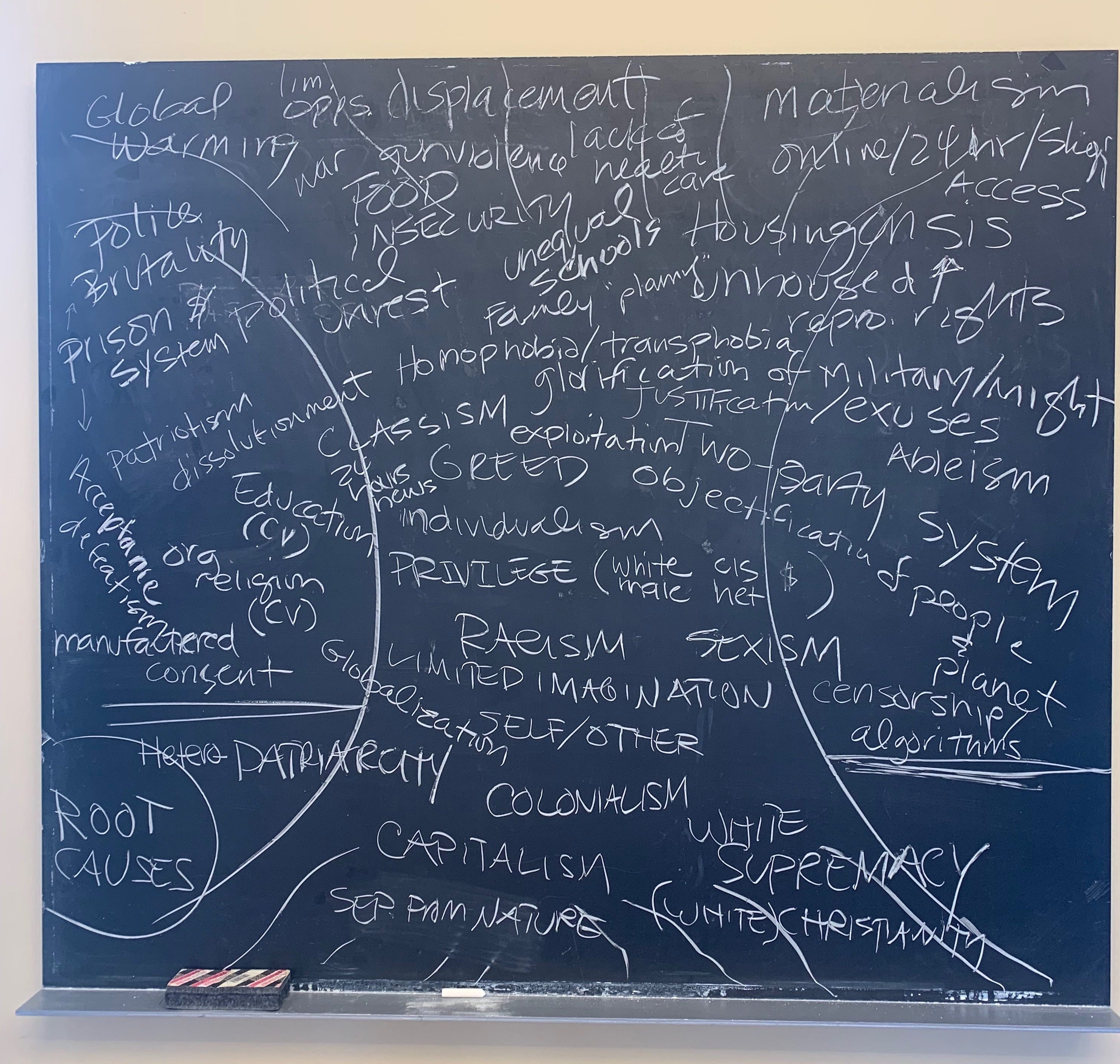
What does resistance look like? I’m sure many of us are already practicing some forms of resistance because resistance shows up in small and big ways, in the local and the global, and in the personal as well as systemic. And here’s my grounding for my resistance work. In addition to being a minister, I am a Peace Educator. Many folks I encounter give me that confused dog head look, wondering what I mean by “peace education,” and others assume I just gather people together to hold hands and sing hippie songs. The reality is that peace education is a critical, radical, consciousness-raising, action-taking, power-dismantling practice and way of being that any and all of us can and should be involved in. Peace education is not just a “can we all just get along” mentality, because peace builders know all too well, that the only way we can all just get along is if we do deep deracination - examining root causes of all the systemic ills, questioning our assumptions about these root causes and their manifestations, and engaging in a multi-perspective critical analysis of how these root causes cause harm which allows us to imagine and create more livable futures. We can never all just get along if members of our community or larger society have been and continue to be marginalized, alienated, targeted, and restricted. True Peace requires the dismantling of systems of oppression and violence and replacing those systems with structures and institutions that are egalitarian, just, humane, and unifying.
In my college courses and my workshops for the Peace Ed Center, we always focus on root causes for a few reasons. In doing so, we get ourselves unstuck from the “issues” because if you’ve ever tried having a conversation with someone who is solely focused on a current problem or community concern, someone who perhaps doesn’t see it as problematic (because it doesn’t impact them), trying to discuss it or get towards solutions can be nearly impossible. Talk becomes very circular. However, if - and this is a big IF - the conversation can explore the root causes of an issue and/or the companion problems of said issue (which stem from the same root cause), maybe, just maybe, a more productive encounter can occur.
For example, K-12 education in the United States, especially in the social studies or history curricula, typically gives one side of any story, and that one side is usually the one that makes the US seem like the best, most powerful, excellent nation to ever exist. The stories we tell are usually of how early US leaders and Christianity “civilized folks” and introduced them to the ever-so-important concept of money. All those history lessons leave out the beginning of the story. Or as author Chimamanda Ngozi Adichie says in her brilliant TED Talk, those stories start with “secondly”. Secondly, the native americans shot at us with bows and arrows. We deliberately leave out the FIRSTLY, because doing so would force us to say the quiet part outloud…firstly, colonizers invaded a land already inhabited with complex societies and when these “West-Whites” (as my colleague David Andersson calls them) said, “ahem, thanks for the food and shelter but now, we’re taking this land…and we’re going to kill you all too”, the people who had a deep connection to the land took their own shot at resistance. It’s very easy to share an incomplete history of an event. But doing so will never allow us to right those wrongs.
Most of us by now hopefully know that the US was founded through genocide and enslavement and colonialism, and imperialism. And today, we are living fully into the fascism that results when one does not honestly reckon with one’s existence. When I hear people say, “This isn’t who this nation is…we don’t treat people like this,”...I do a double-take. Really? The United States, after obliterating the indigenous people of this continent and then creating unimaginable generational wealth off of enslaved people, went on to destabilize dozens of countries around the world, creating inhumane and unlivable circumstances for countless people. After committing genocide on our own turf, our elected leaders went on to commit genocide directly or through funding and weaponry in other parts of the world, including but not limited to Guatemala and, most recently, Palestine. This is exactly what this country is. And perhaps for many people, since the effect of imperial policy isn’t directly felt - because they’re not part of the targeted groups (yet), it’s hard to connect the dots. But ask anyone who is part of what Antonio Gramsci calls the “subaltern” and you will hear a different story. We must all connect the dots, and if we don’t have the tools, then find them.
The folks who cannot reconcile with the real history of the USA are also the folks who call the US a “melting pot” when, in actuality, we are closer to a “salad bowl”. Sure, lots of ethnicities and cultural groups live here, but they/we certainly don’t live together in some great amalgamation of unity and cooperation. Our leadership has made sure of that. Oftentimes, the only thing that binds folks of different backgrounds together is poverty. Now, the USA is really good at that. Did you know that 1 in 8 USAins receive SNAP benefits? 1 in 8. That’s 12% of our population that does not have enough food to eat. And the average US household carries $100,000 in debt. And then there’s our for-profit healthcare and prison systems, as well as our Foucaultian visions of education… Remember too, that when the War Resister’s League does their annual analysis of the US Budget, the military budget always amounts to between 46 and 52% of the budget, and things like human services - food stamps and education, receive 4% or less. Our entire society is built upon the Root Causes of Racism, Patriarchy, Cis-white-heteronormative Christianity, Militarism, and Capitalism.
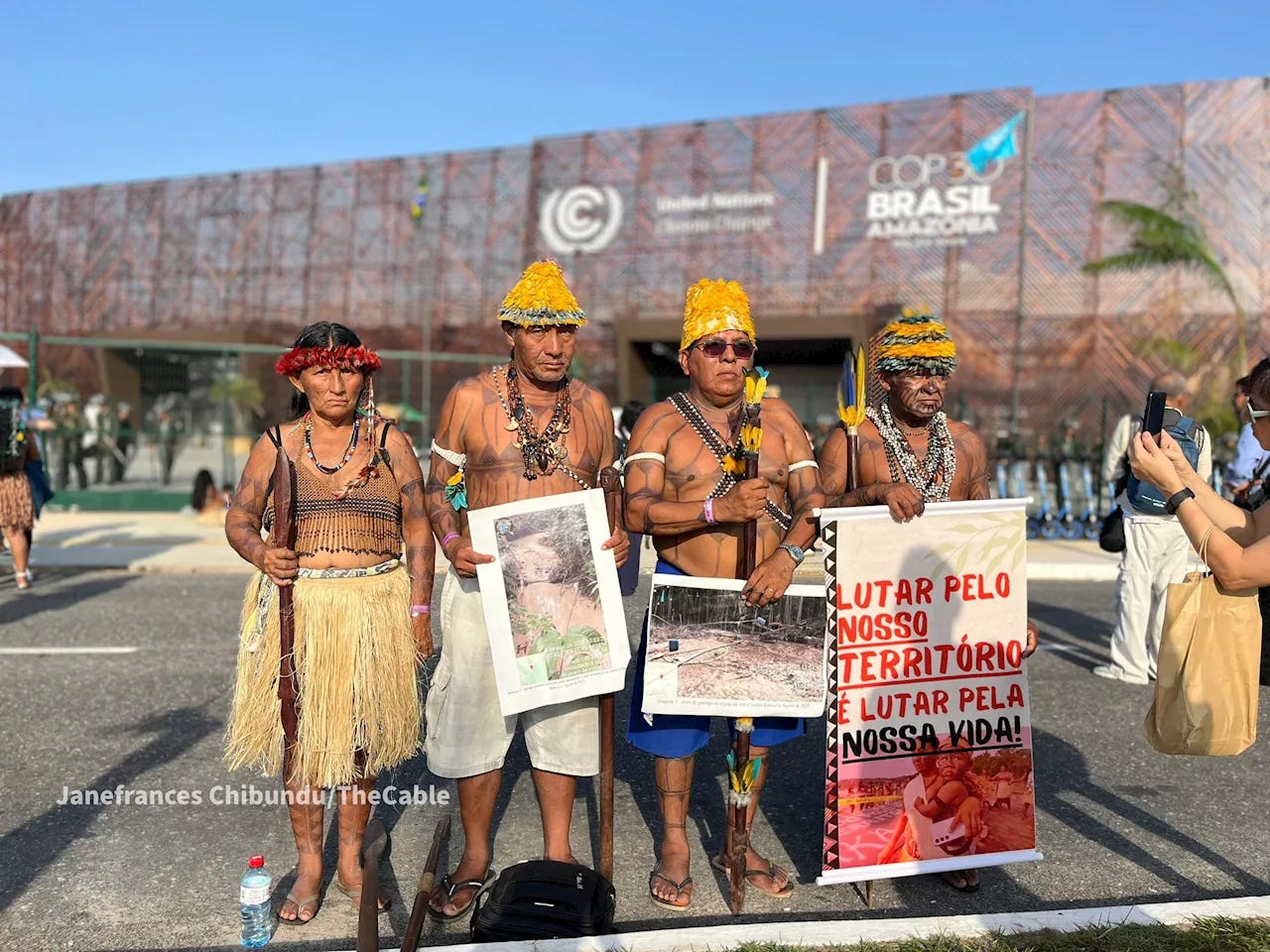
But this unfathomable monster that we are up against can and must be resisted. Resistance is indigenous Amazonians showing up at the feckless COP 30, causing a ruckus so that their voices will actually be heard. Resistance is the Global Sumud Flotilla sailing at great risk to feed the starving people of Palestine. Resistance is street art - from murals to Banksy to graffiti - raising awareness. Resistance is students across the country creating peaceful encampments to force their colleges and universities to rethink investments and practices. Resistance is the National Park Service creating “altNPS” to push back against unconstitutional restrictions placed upon them and their social media posts (while also trying to protect national park land). Resistance is communities creating anti-ICE street units to track and chase them out of town. Resistance is choosing not to invest in fossil fuels, war machines, or prisons, if you’re lucky enough to have investment accounts. Resistance is saying no to materialism and overconsumption and horrific companies like Amazon, even though all the ads tell you that you’ll feel more whole if you do. Resistance is not using AI because you know the extreme environmental impact it has. Resistance is giving up a convenience for yourself so that someone else can exist free from harm. Resistance is saying no to something that does not align with your values. Resistance is mutual aid (not charity or false generosity) as mutual aid builds community and networks.
These examples have a few things in common, but I want to highlight the Root Cause for all: Capitalism. Capitalism is antithetical to healthy existence. Capitalism requires unchecked infinite growth to survive, and we live on a planet with finite resources. Capitalism requires the exploitation of people and planet, and if we care about our neighbors and other co-inhabitants of Earth, we must resist the siren song of capitalism. So if you make one change in your life, resist the ills of capitalism.
Resistance begins with our personal choices, where we can all take time to connect the dots to see the repercussions of our decisions, where we get our groceries, taking part in the BDS movement, turning off AI options on our devices, supporting local businesses, eating seasonally and locally, flying and driving less, not buying plastic, etc…
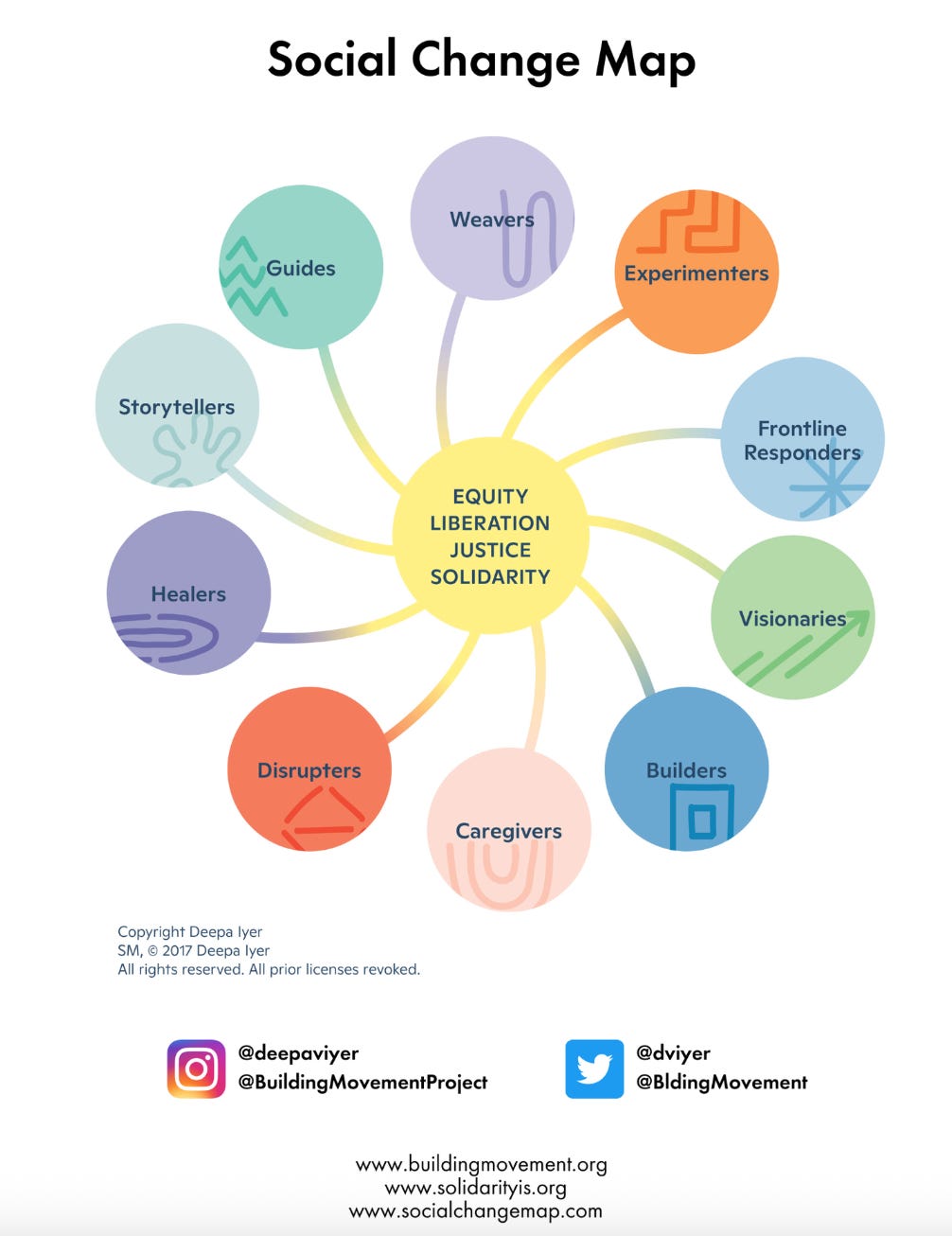
Our work in collective resistance can take many forms, and not all of us need to resist and take action the same way. We can’t actually. We’re all made differently, and what works for one person won’t work for someone else. We have to play to our strengths. The Building Movement Project shares ten roles one can take on. I’ll read them twice and see what resonates with you: Guides, Storytellers, Healers, Disrupters, Caregivers, Builders, Visionaries, Frontline responders, Experimenters, and Weavers. (Get Deepa Iyer’s Workbook). I know which roles I’ve been called to during my years of peace and justice work. And I know that by collaborating with friends and colleagues who have taken on other roles that our work complements and supports each other.
All of these roles require commitment and risk. As my mentor, the late Dr Betty Reardon, who founded the field of peace education, wrote about, risk is a necessary part of peace work. We cannot hope to undo the violence deeply embedded in every aspect of our society by being safe or playing nice. When we speak and act out against tyranny, we take a risk, and it may be scary, but we know the far greater risk is to stay silent and allow the powerful, cruel few to harm our much mightier collective.
When I need inspiration, I dip into the well of my ancestors, in particular, I consider the Italian sovversivi- the subversives - who stood up to Mussolini. Journalist Oriana Fallaci, as a teenage girl, carried messages and anti-fascista documents in her bicycle basket across Florence to help her parents, who were part of the movement. My friend Juliet’s great-grandfather founded a pro-socialist newspaper (in Italian) upon his arrival in NYC, even though he was on Mussolini’s hit list. I recall the lyrics to “Bella Ciao”, the socialist fight song, that reminds us that we may have to die for liberty. And, I think of my great-great-uncle, who was allegedly part of the Garabaldini who fought for the unification of Italy and an end to unfair monarchical rule. When I harness my lineage, I can make brave choices. Just this past October, I was the opening musician for the annual Kingston Italian Festival. I was asked by the organization (UCIAF) to sing the national anthems of the USA and Italy. While I had less of an issue singing “Fratelli D’Italia” (although since Italy elected a neo-fascist in Giorgia Meloni, I wasn’t keen on it), I had no interest in singing our national anthem - a song written by a slave owner that glorifies war and includes the lyrics “land of the free and home of the brave”, amidst masked ICE roundups, disappearances of citizens, the creation of Alligator Alcatraz, and the ongoing support for a genocide in Palestine. So, after stressing about it and trying to find ways to maybe change the lyrics or sing it in Italian instead of English, I simply told them I wouldn’t do it. And it was fine. They got another vocalist for it, so perhaps I didn’t make much of a difference, but I did at least stick to my values, and then when people asked, I was able to begin a conversation about the aforementioned atrocities and our role in not playing along. The best part of this experience, though, was right before Jess - my piano player - and I performed Bella Ciao, I shared that the thing that makes me proud to be an Italian was the dockworkers refusing to be complicit in murder, which led to a countrywide strike for days! Did you see that footage? And when RAI interviewed folks who were stuck in traffic or couldn’t get on their trains, no one complained. The Italians knew what they were standing up against because they had been there before. We need more actions like that here. It is time for a General Strike!
We also have to remember that we, living here in the USA, have been there before, and thankfully, our UU ancestors have given us examples of resistance. Theodore Parker, as a staunch abolitionist, kept a shotgun at his desk lest anyone try to “claim” any of the Free People in his region. James Luther Adams returned from 1930s Germany, after witnessing the rise of the Nazi’s and told all preachers that our role was to be vocal and active parts of social movements. Margaret Fuller wrote a manifesto for women’s equality, and Frances Ellen Watkins Harper not only refused to give up her seat on a Philadelphia streetcar, but also went on to write anti-slavery themed poems and books.
Our government right now is testing us. Any student of World War II knows that fascism and tyranny are strategic. Meted out in steps to ensure full penetration. Division and discord, and propaganda are its tools. To counteract this, our resistance must be inclusive - listening and following the lead of those who have historically been the most oppressed and marginalized, as well as young people who are fully aware that their future existence is at stake. We have to honor alternative epistemologies, other ways of knowing and being that may be challenging for us to grasp, and I say this especially to us older activists; we must stay open and receptive to modes and methods that may be unfamiliar to us, so we can learn and expand. Our Resistance must be aligned with our values; we have to always remember our “true north” as it were. Which means, it must be grounded in LOVE (among other things). Our love of humanity, our love for planet and place, our love for justice and transformation. Our love for the future world we want to create. As Che Guevara reminds us, “the true revolutionary is guided by great feelings of love.”
Betty always reminded us - her peace minions - that this work is long-haul work…and it has been a long haul. Our timeline now seems shorter. We have much work to do. And that’s why I chose the phrase “keep on keeping on” to frame my talk. Things feel - ARE - daunting, but we need to keep on keeping on. If we want a better world, we have to imagine it, and then we have to live it into existence. In the song “Keep on Keeping on”, the great Curtis Mayfield says, “The overall thing is that they be cool and keep on keeping on, but remember that love, basically, is the way, and we’re gonna keep on keeping on.”
In order to keep on keeping on, though, we need to be resilient. We need to take care of ourselves and our fellow comrades. We can do this communally - through support groups, working together, and spending time with people who lift us up and inspire us. Engaging in dialogue and conversations that invite you into deep knowing of someone else. I personally am grateful that I get to spend most of my time with young people whose questions, observations, and ideas are profound. They fill my cup and remind me of what is at stake. Also, personally, taking breaks when you need them, getting rest, being outdoors, and exploring your creative outlets. And of course, as people of faith, we need spiritual practices, things well beyond Sunday Service. Maybe it’s meditation or prayer, or journaling, or sound baths, or sitting among the trees, or listening to John Coltrane. Stay connected to your spirit and stoke the fire of your commitment.
I just quickly mentioned taking breaks and getting rest, so I want to reiterate that. I’m hoping you already know the work of Tricia Hersey, who wrote “Rest is Resistance”, a must-read. Hersey reminds us that REST is an act of resistance in a society that demands so much from us. We don’t rest so we can do more, we rest because rest is necessary, and I would argue it is part of our natural state of being because I’m pretty sure humans were not meant to work 80 hours a week (or even 40 for that matter!). So while rest is a way to sustain us, it’s also a way to opt out of the capitalist grind.
This work we are called to do requires a reprogramming. First, we have to deprogram ourselves (and others) from the teachings and pernicious internationalizations of racism, patriarchy, capitalism, militarism, and materialism using the tools of examining root causes and engaging in open-hearted and open-minded dialogue. Then, we can reprogram ourselves into the values and practices of reciprocity, community, and simplicity, and others that support our calling to Resist. We can make every act we do an act of Resistance. We can be models that demonstrate “this is not normal!”
And just know that all of us gathered here today, in person and online, have not allowed the oppressive machinations of the world to crush us. The fact that we FEEL and that we SHOW UP means we are already resisting, and with our community, we can keep on keeping on.
Brilliant. The mental gymnastics of needing to use platforms you actively dislike for good causes is real. What if we eventually build decentralized, open-source social networks, powered by ethical AI, that truly serves communities without the brain-softening side effects? A teacher can dream!