

Militarism in the School System
Thought I'd keep this theme going...

I figured I’d continue my thoughts on militarism and focus on how militarism shows up in schools (and formal education in general). I’m entering my 32nd year of being an educator in some form and I never stop being appalled at how education so easily serves as a form of cultural violence. I firmly believe in free public education - I see it as a Human Right actually - yet after all these years, I remain incredulous about what we deem as ‘acceptable’ in so many public schools. I’m talking systemically here and in no way am I judging teachers (there are enough folks who have no idea what it’s like to be in a classroom already doing that). From my days teaching in K-12 classrooms or working as a teacher-educator, I know that most teachers want their students to become thoughtful, concerned, critical, and creative members of society but they are forced to function within a system that gives them decreasing opportunities to do so. (And, to be fair, in the many years I’ve been at this, I’ve also encountered teachers and administrators who should be nowhere near children because of their militaristic, racist, sexist, and homophobic beliefs. But maybe that’s for another post.)
Militarism is omnipresent in schools and the reason we don’t name it as such is simply because we don’t see it because, it is, in essence, the very air we breathe. We are so conditioned to accept the structurally violent system we live in that manifestations of it are just…invisible to us. But, many people do see it. Maybe they don’t call it militarism but the folks that question “why do schools look like this?” are probably noticing the more militaristic aspects of education. Now, excluding the obvious—military recruiters on campus and Jr ROTC programs (that not-so-coincidentally are more present in areas with high concentrations of poor people and people of color)—how else does militarism show up?
To keep a national mindset that fully accepts (and even celebrates) the United State’s Imperial Power via rampant militarism, schools become the vehicle for this inculcation through what is commonly called the “hidden curriculum”. The agenda of this hidden curriculum is primarily about molding docile bodies (to use the language of Foucault) to become obedient and compliant members of the Capitalist Economy and US War System. What do I mean by that? Have you ever asked yourself why we demand that young children sit still for extended periods of time even though it is counter to everything we know about child development? Have you questioned why schools make children line up and walk silently through hallways in (oftentimes) gender-segregated lines? Are you curious about why kids have to raise their hands before they are acknowledged by a teacher? Or they have to ask to leave the room to take care of their regular bodily functions? Or why they are subjected to high-stakes testing that requires one right answer actively removing nuance, interpretation, and creativity from assessing student learning? Or why the ‘banking model’ (thanks for the language Freire) is the dominant mode of teaching, especially when kids get older and begin to engage in the developmentally appropriate act of questioning what they are being taught? None of these methodologies are accidents. All are designed to limit the autonomy and agency of children. All are ways to ensure that they become rule-followers who (whether consciously or unconsciously) come to understand that education is solely a means for them to fit into the current paradigm rather than create an alternative, more humane, and caring world.
Peace educators - and other critical pedagogues including Freire, hooks, Noguera, and Love - know that education is political. From its foundations in the US to implementations today, there has always been a political agenda and to deny that is well, foolish. Especially if the political agenda, as it stands, is to continue to use schools as a means to support war, imperialism, and exploitative capitalism.
We can do things differently. There are models out there that subvert the militaristic mindset and I’m happy to share some with you. We can also engage in a process of collectively imagining the alternatives. Last fall, I taught a First Year Writing Seminar about “Educational Opportunity in the United States”. Towards the end of the semester, we explored militarism and my young students (17-19 year-olds) were not only able to critically examine their experiences of militarism in their schooling (the list on the left), but they also developed awe-inspiring alternatives (the list on the right).
Check this out:
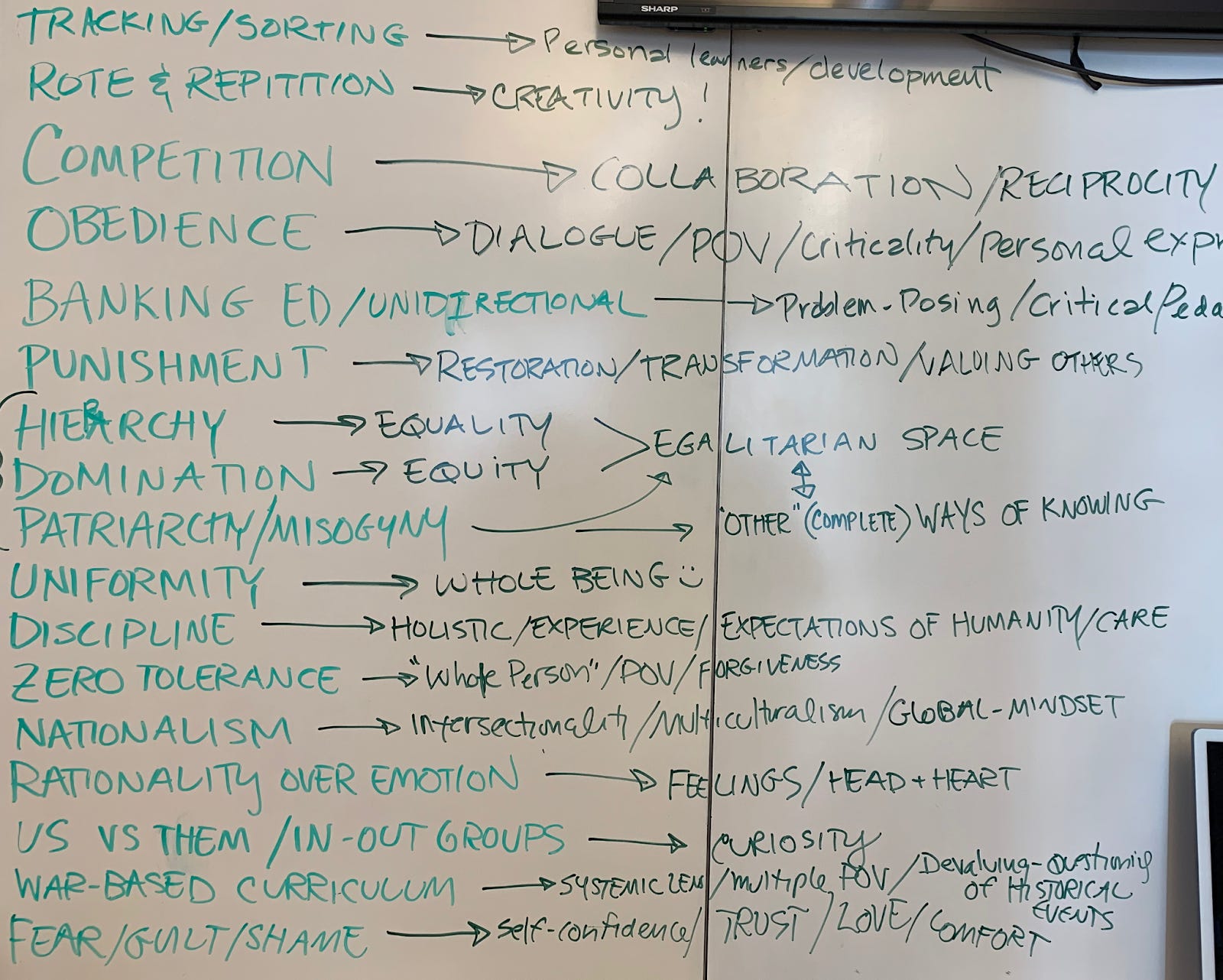
That right column….that’s what I want education to look like! Let’s make it happen.