

On academic writing...
and links to my recent publications (free)!

Growing up, I was not much of a reader, and certainly not that into writing. My high school forced us to read only “the classics” [Read: dead white guys] (par for the course in a working-class school in the early 1980s) and since I was enamored with the STEM fields, writing was not something I thought much about. It wasn’t until my first round of graduate school—getting my Master's in science education—that I started to write regularly. More graduate school expanded my writing and then, I became an academic, and writing—and publishing—became a necessary part of my life. I came to love writing, but not the pressure to produce.
When I left academia in 2007 to run a not-for-profit, I took a break from academic writing for a long stretch. My focus shifted to grant writing and publishing short articles for places like HuffPost or STEM-related publications. And, sadly (since I love doing research), the only research I did was focused on the evaluation of our programs. Then, when I opened Storefront Science—my experiment in place-and-play-based science education—I found time to start blogging about science learning and peace education. Those musings led to the publication of a book about doing science with young children.
My writing journey continued when, while attending seminary, I learned to ‘write theologically’ and cranked out paper after paper on Engaged Buddhism, Interfaith Dialogue, the connection between religion and violence, and so on. At some point, I hope to revisit those pages (buried somewhere in a cardboard box or a Drive folder) and bring them to new life here on Substack.
Now, that I’ve returned to university life as a Visiting Professor, I don’t really have the ‘demand’ of publishing. Something in that freedom has inspired me to do research again (yay!) and to organize my thoughts into articles for academic journals (Yay!).
Starting this Substack was a way for me to write non-academically about the things I think about All The Time because one (major) issue with academic journals is that the articles are often hidden behind a paywall that folks can only access if they are affiliated with an educational institution or university library. Sometimes if you dig enough, you can find them through other sites but I’m always frustrated by that wall: Don’t we write these things so people can read them?
Two years ago, I published a piece entitled, “Science, Spirituality, and Climate Change”, the first time I formally pulled together my teaching, learning, research, and writing foci of the intersection between science and spirituality to address the ills of our time. I shared that article with a handful of people, one of whom encouraged me to “write it less academically and share it with more people!” I plan on doing that shortly. (I also translated it into Italian, so maybe I can share that too!)
In the meantime, however, I have had two articles published this month in (wait for it) Open Source Journals - meaning, anyone with an internet connection can check them out. So, my post today—and if you are still reading this, thank you very much—are two small excerpts of these articles with links to read them.
My focus for the past 10 or so years (well longer if you include what I did as a science teacher, museum educator, and professor of science education), has been bringing together my thinking about peace education through the lens of science and spirituality to address climate chaos. It helps that a) my original field of study (and work) was in science (biology and ecology), b) my doctorate is in Peace Education, and c) I have a Master of Divinity degree. It only makes sense to bring those three modes of thinking together!
So here they are:
The first piece is
“Peace Education, Transformation, and Responding to Climate Chaos”
https://openjournals.utoledo.edu/index.php/infactispax/article/view/1209
As an educator with thirty-plus years of experience working in classrooms, non-profits, and universities, as well as in informal settings, I am a firm believer in peace education, thanks to its conceptual framework of the interconnected manifestations of violence and its use of critical multi-lensed pedagogy to examine and address root causes. When coupled with a spiritually grounded conception of transformation that reorients our way of being in relation to Earth and all forms of life, the methodology of peace education can facilitate the wholesale shift in our global mindset/habitus needed to work against the forces of climate chaos. I contend that peace education is the best teaching methodology to address climate chaos if we deliberately facilitate learning experiences rooted in anti-capitalism, pro-indigeneity, and transformative, Earth-centered spirituality, promoting values of Community, Cooperation, and Interdependence.
The second piece is
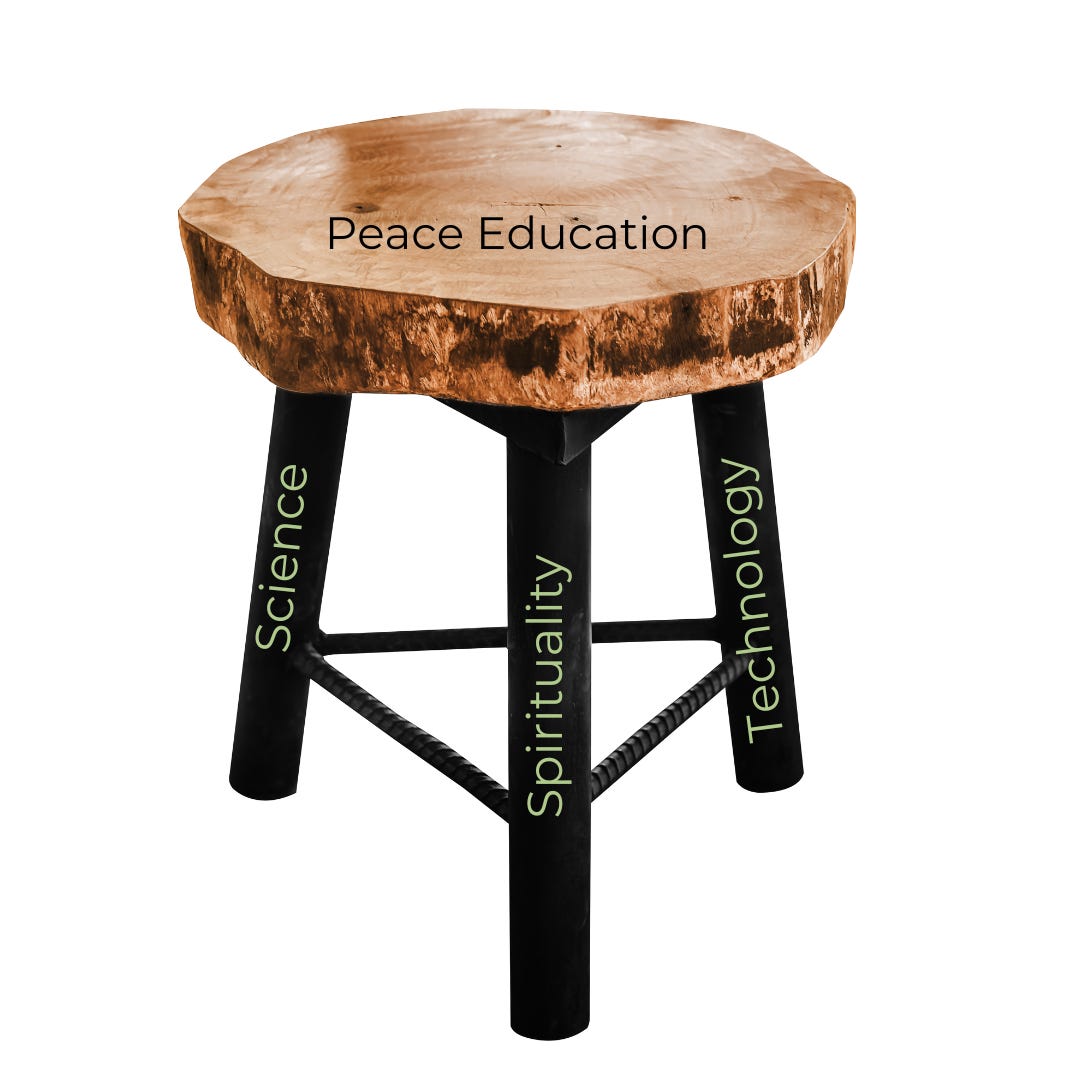
“Three-Legged Stool: A Peace Education Framework for Weaving Together Spirituality, Science, and Technology”
https://www.zygonjournal.org/article/id/11056/
In this article, I share my “three-legged stool” framework for considering planetary health and imagining solutions for the climate chaos and environmental injustice in which humanity is mired. The three-legged stool analogy is often used when describing a conceptual structure because it represents balance. While many are more practically acquainted with stools (and chairs and tables) with four legs, the three-legged stool has existed for ages simply because it provides balance on uneven ground, which can be quite handy when, say, milking a cow. The balance analogy, however, goes beyond functional usage, as it also implies that the three legs of the stool must be of the same length, meaning that each leg of a conceptual three-legged stool must be examined and applied equally. For my purposes in discussing climate chaos, peace education is the overarching paradigm and the seat of the stool is supported by the following three legs that will be interwoven throughout this discussion: science, which provides data and understanding; technology, which provides possibilities and solutions; and spirituality, which provides grounding and the tools for holistic transformation.
If you don’t want to read the full articles, I will pull out some choice nuggets to share here, but if you do read them, feel free to email me and let me know what you think!