

Updating and Implementing Core Values
…and why we need them!

When I started my path as an educator 30+ years ago, I had strong convictions about the power of education and my role as a teacher. I suppose you could call those convictions ‘values’ seeing that I used them to ground my work then and now. I don’t think those core values have changed much for me over the years. I still know that justice, integrity, and curiosity make up my personal compass, as it were.
When I began my studies with Betty (Dr Betty Reardon, mother of peace education), I read her book “Comprehensive Peace Education” and discussed with her and my classmates, the three Core Values she put forth for Peace Education: Humane Relationship, Planetary Stewardship, and Global Citizenship. Betty said that “defining values is necessary to articulating and determining preferences and to the formulation of policy alternatives and options for action.” Meaning, that we must know (and name) our values if we are to create an alternative system—especially if we are imagining a system that is so very different from that which we currently live.
To keep things brief, here’s a nutshell view of Betty’s Core Values:
Planetary Stewardship - relationship with and respect for the planet
Global Citizenship - non-violence and justice in the social order
Humane Relationship - the interconnectedness of all life
Betty’s Peace Education values have informed all of my work over the past 25 years, whether I was creating an engineering curriculum, teaching science to preschoolers, leading urban environmental explorations for kids and families, or teaching undergraduate and graduate students. Heck, these values even informed how I approached ministry and were always in my mind when I was writing sermons!
Just last year though, thanks to a student of mine who pointed out that while the content of the values was spot on, the language of these values was a bit outdated and maybe a little too human-centric. At Sophia’s prompting, I began to reimagine these values as they related to my peace education work - to see how to make them more inclusive and expansive. I continued to explore my reimagining after another conversation with a colleague at the IRAS conference, and this is what I came up with.
Holistic Earth Care
Relational Existence
Global Consciousness
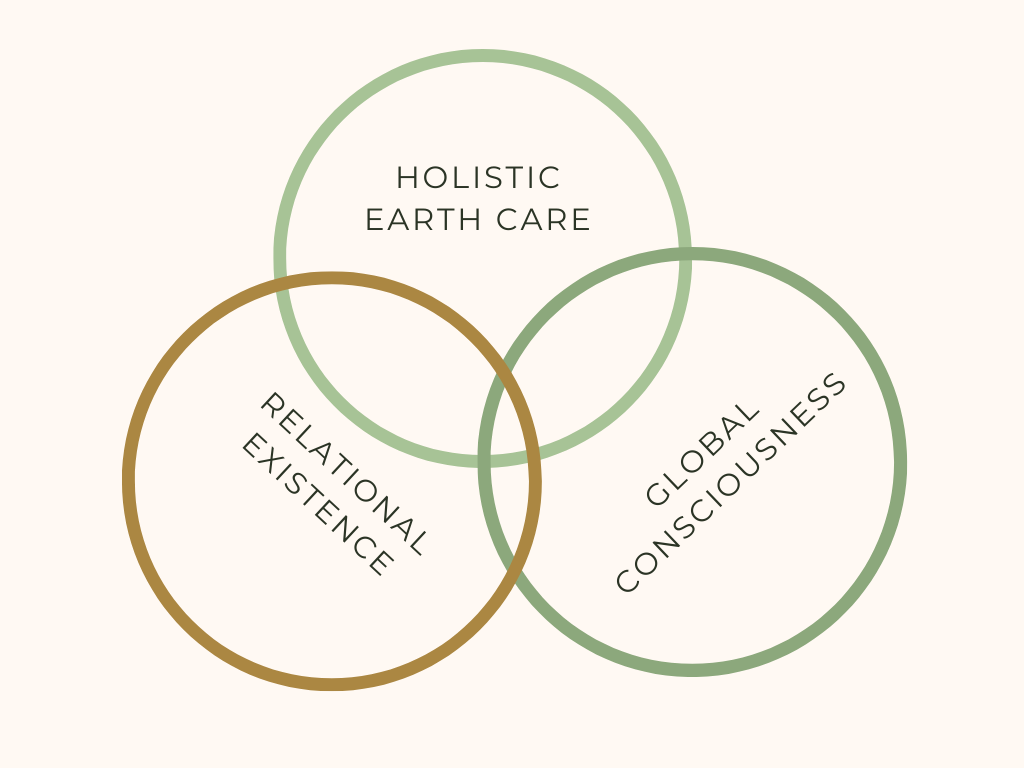
Holistic Earth Care calls us into an acknowledgment of interdependence, interconnection, and interbeing as described by Vietnamese Buddhist Monk Thich Nhat Hahn. We are all responsible for caring for the planet on local and global levels, not because we are “stewards” in any traditional sense but rather because we are of the Earth and all its parts are within us. We are not separate but deeply dependent—think of the Buddhist concept of Dependent Co-Arising wherein we must acknowledge that any sense of individuality is impossible because all existence is connected to and/or arises from other members of our Earthly sphere. Without understanding that Earth care requires us to see all life, including things typically deemed “non-living” or abiotic, as fundamentally one or united, we will continue to fall into a trap of separation or superiority: that humans are above all other life forms. A value of Holistic Earth Care serves to mitigate the effects of structural, cultural, and direct violence as they show up in a culture that views the planet as a commodity to be exploited. Simply, to paraphrase Unitarian Universalism’s seventh principle, we all have a responsibility for the interconnected web of life of which we are a part.
Relational Existence is an invitation to consider how we relate to and interact with all members of our community on a variety of planes and scales, spanning from the interpersonal, and communal, to the global. If we remember that our existence is grounded in and founded upon relationships, we are called to more mindfully interact with others and to cultivate reciprocity. This requires a few things. One, we have to see ourselves as relational beings. Two, we have to make peace or—at the very least—acknowledge that our current state of affairs is a result of creating hierarchies in relationships and that we deem certain peoples as beneath the need for relation. This has made and continues to make it perfectly acceptable to exploit and kill without regard to the inherent dignity of those we deem other. Finally, a true sense of Relational Existence seeks to right the wrongs of the past and thus requires that we defer to voices who have historically been marginalized, many of whom demonstrate a relational spirituality and/or model of living in a relational community with all beings. Simply, we must see and honor the inherent worth and dignity of all beings and act in accordance with their rights, whether as humans, other mammals, or other forms of being. Relational Existence diminishes manifestations of violence by inviting us into mindful, compassionate relationships via authentic communication.
Global Consciousness invites us to see ourselves as part of a global system, not merely as an individual or members of an exclusionary definition of community. If, as Carl Sagan is famous for saying, “We are all star stuff” then it would serve us to call into question the barriers and deleterious forms of separation that we cling to, including notions of borders, private property, and the NIMBY mindset. We must see ourselves as co-travelers of the cosmos and thus, live with a sense of responsibility to all inhabitants of said cosmos, not only those who think or look like us or live next door. Climate Chaos has proven that local choices—primarily lives lived in excess that require fossil fuels and extractive, exploitative capitalism—have global impacts. Global Consciousness can counteract the manifestations of violence by expanding our understanding of the human condition and the nature of interdependent existence.
What do you think? What values guide your call to transformation?